
⏱️ The 89th edition of our newsletter is a seven-minute read.
👋 Hi all, Ellie here – your reporter for The Mid North Coaster.
📣 Call out for upcoming events: I’m working on my What’s On coverage for the month of February, so if you know of any family-friendly, live music and other events feel free to send the details to me by simply replying to this email.

In case you missed it:
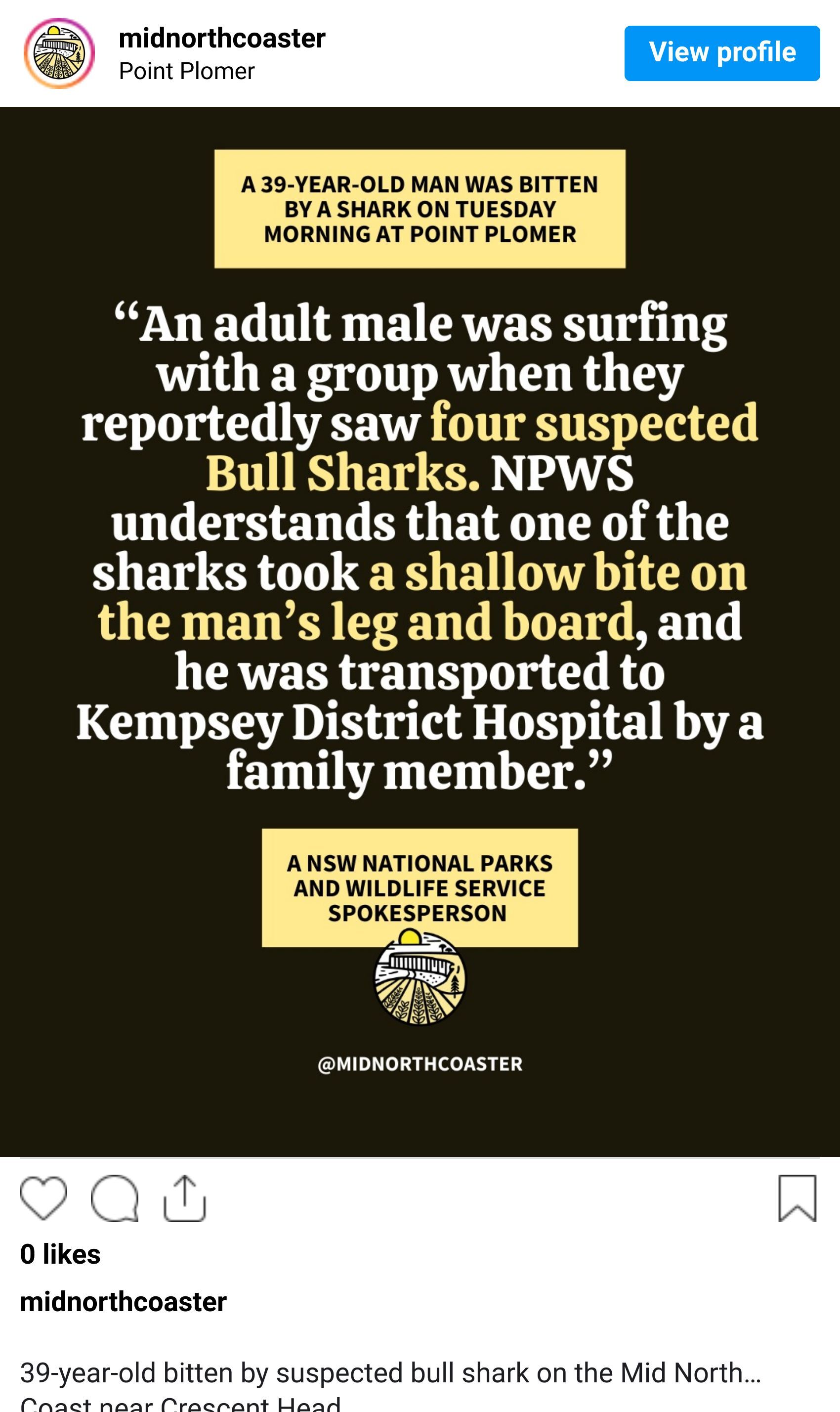
A man was bitten by a suspected bull shark on the Mid North Coast
What happened: On Tuesday morning (January 20) a 39-year-old man was bitten by a shark while surfing at Point Plomer in Limeburners Creek National Park, near Crescent Head.
He was driven to Kempsey District Hospital by a family member where he was treated for minor injuries. He has since been discharged from the hospital.
A spokesperson for National Parks and Wildlife Services (NPWS) told The Mid North Coaster the man was surfing with a group when they reportedly saw four suspected bull sharks.
“NPWS understands that one of the sharks took a shallow bite on the man’s leg and board,” the spokesperson said.
NSW Police Media Unit said the man “sustained a wound to his chest”.
Beaches from Crescent Head to Port Macquarie’s Town Beach were closed following the incident and may remain closed today.
The incident is the fourth confirmed shark attack in NSW since Sunday.

Shark incident reported on Dorsal.
🗞️ In today’s top stories we’re looking at a Mid North Coast couple who used passive house principles to build their new home and are already seeing the savings on their energy bill, plus a group of ladies who have spent a decade raising money to purchase machines and furniture for local cancer patients.
Let’s dive in…
🏡This Mid North Coast couple spent $60 on electricity in three months

The Karks built using passive house principles.
Mid North Coast couple Emma and Scott Kark have lived in their new passive home for a little over a year. Their electricity bill for the last quarter was $60.
With their solar system hooked up in November, this figure is expected to drop.
💡What happened: When the Karks bought one hectare in Verges Creek, Kempsey Shire, they knew they were going to design and build a home using passive house principles.
Why? Because they wanted to live sustainably – both environmentally and financially – and comfortably.
❓What’s a passive house: A passive house is a design standard that optimises the “thermal envelope” (the layer separating inside from outside) of a building.
Such a house requires minimal heating and cooling by using insulation, airtightness, appropriate window and door design, and ventilation systems with heat recovery – a system that draws in fresh external air and extracts heat from outgoing, humid air for temperature control.
The design ultimately uses less electricity, saving money for the homeowner, while reducing their carbon footprint.
🌏 Designing for the current climate: With a warming planet and rising utility bills, passive homes make sense.
The Karks hired an architect who specialises in passive house design.
Their single-storey, two-bedroom house is not only well-insulated, it’s vacuum sealed, eliminating any drafts. The airtight building has a vapour barrier wrap under the external cladding that prevents external moisture like rain entering, while allowing internal water vapour to exit to avoid damp and condensation.
The home has double glazed windows, and a heat recovery ventilation system. It’s north-facing and the floors are made of concrete to utilise sunlight to warm the home. Scott built a pergola on the west-side of the house and curtains are used in their west-facing bedroom during the warmer months to keep the house cool.

Inside the Karks’ home. Pictures supplied.
💰 The bottom line: The build cost the couple about $460,000, not including the architect fee.
Emma said it “cost a bit more than building a normal house” but that some of the elements - recycled timber cladding, burnished concrete floors and large windows and sliding doors - were personal choices and not integral to the passive principles.
Regardless, the couple say the extra upfront outlay is already being paid off.
“We definitely didn’t need the heater in winter. So we saved there,” Emma Kark told the Mid North Coaster. “I absolutely hate winter, and I hate being cold, but this was my favourite winter ever, because I barely even noticed it.”
This summer temperatures in Kempsey Shire have peaked in the low 40Cs.
“It has been quite hot,” Emma said. “We do sometimes put the aircon on, but only for an hour and it'll cool down the whole house. So it is really efficient at circulating air throughout the house.”
⏩ Future of housing: Emma says passive design “should be the future of the housebuilding industry, from not only a sustainability point of view, but just a comfort point of view because it does make such a difference”.
🦺 Home Energy Assessor: Coffs Harbour’s Christopher Oakes is a carpenter. Born in Ireland, he has worked on passive houses in his home country, and believes they are important for our future.
Since moving to Australia he has become an accredited Home Energy Assessor, helping homeowners make changes and plan ahead to improve the energy efficiency of their existing homes while reducing their carbon footprint.
“This is an area where Australia is really lagging behind,” Oakes told The Mid North Coaster.
He says Australians need to bring houses “up to standard if we want any chance of hitting our carbon reduction targets of net zero for 2050”.
🌡️ Rising temperatures: Australia’s National Climate Risk Assessment shows in detail how climate change is impacting our communities, economy, infrastructure, environment, health and way of life.
The assessment also shows the difference between a rise of 2C in pre-industrial temperatures and a rise of 3C. As an example, there are currently about four severe/extreme heat days per year nationally, but under a 3C warming scenario this would climb to 14 days.
🏡 For all homes: New builds and existing homes can benefit from the passive house concept. You can learn online or consider hiring a home energy assessor to visit a home, measure the performance of the dwelling and the running costs, and present a plan on how the residents can make it better.
Oakes recommends changing lightbulbs to LEDs, and says the biggest contributor to home energy bills are hot water and swimming pools.
“Nothing else out there pays back as good as investing in things like solar, or a heat pump,” Oakes said. “Give it five or 10 years and you’re making money.”
A home energy assessor can cost between $300 and $500, sometimes more depending on the job.
P.S. I’m meeting Emma and Scott this afternoon to take a tour of their home. Keep an eye out for the video.

🧞♀️ Mid North Coast oncology units send their wish lists to the Lilli Pilli Ladies
Pig racing is just one of the ways the Lilli Pilli Ladies have raised more than $470,000 to buy equipment for oncology units in Port Macquarie and Kempsey.
In doing so, they have allowed some patients to receive treatment locally rather than having to travel.
💡 How it started: In 2016 friends and retirees Judy Saul and Lyn Gleeson invited a few people they knew for afternoon tea, with the goal of raising a little money for cancer patients. They were invited to bring a friend.
About 50 ladies turned up.
The afternoon was such a success it became an annual event, and so began the Lilli Pilli Ladies, named after the flowering bushes.
🚘 Travelling for treatment: Initially, all money raised went to the Mid North Coast Cancer Institute at Port Macquarie.
In 2023, after hearing stories from cancer patients living in Kempsey about having to travel for treatment, the group lobbied the Mid North Coast Local Health District (MNCLHD) and Mid North Coast Cancer Institute for a cancer unit in Kempsey.
In 2024, low-risk chemotherapy treatments became available for patients at Kempsey District Hospital. The unit is currently operating at full capacity, treating patients three days a week.
The Lilli Pilli Ladies’ recent fundraising has gone towards five reclining treatment chairs for the oncology unit in Kempsey. They are due to arrive in coming weeks.
The women also raised more than $57,500 for an Echo Ultrasound Machine, plus $13,200 to train staff how to use it.
“We consult and work with the local area health oncology team, who advise us of a wish list of equipment required for Kempsey and/or Port Macquarie units, which we then work towards to purchase,” Treasurer Robyn Mainey told the Mid North Coaster.
“We continue to support Port Macquarie Oncology Unit, as many high risk Kempsey cancer patients still need to travel for their treatment.”
💰Money raised: To date the Lilli Pilli Ladies have raised and donated funds totalling $474,292. A 10th anniversary goal is to reach $500,000.
The fact that volunteer groups such as the Lillii Pilli Ladies are required spotlights health funding shortfalls in the region.
“We are happy to continue working to fill the gaps and lighten the load for the local oncology services. We just want to focus on helping local cancer patients and doing everything we can do for them,” President Judy Saul.
Today, there are 10 Lilli Pilli Ladies. Their key projects are organising the annual afternoon tea and golf day.
The pig races - where porkers had to trot around a hay bale obstacle course out the back of Frederickton’s Fredo Pub - is on hold this year, but hope springs eternal. Last year’s event raised more than $11,000.

📹 Hate speech laws and gun reforms
Looking at news at a national level we have our reporter Archie Milligan over at the National Account. Here’s his breakdown of what’s happening in Australian politics…

Thanks for reading, I hope you enjoyed this edition. I’ll be away on Thursday and Friday to meet my new niece, but I’ll be back next week with more stories and newsletters.
In the meantime keep an eye on our Instagram, TikTok, YouTube, Facebook and website for more local news today.
Ciao for now,
Ellie