
⏱️ The 98th edition of our newsletter is a six-minute read.
✋ Hey Mid North Coasters, it’s Ellie.
📢 Today’s call out: This week I’m covering flood insurance and looking at how government and insurers can work together to make it more accessible.
I’d love to speak with someone who lives in a flood-prone area and who can’t afford flood insurance.
I’m also keen to talk to people who have had their homes flooded about the experience of recovering after the disaster.
➡️ Please reply to this email if you’d like to share your experience, and I’ll set up a time for a phone chat.
And remember, anyone can get in touch anytime! Just hit reply to say hi.

In today’s newsletter we’re delving into:
A bit of local trivia about Port Macquarie’s Windmill Hill and what the thing is sitting atop it
Remembering a respected community leader in Kempsey who played a crucial role in securing land under Native Title legislation.
What a sustainable home is, why it matters, and how you can cut costs and carbon emissions – from small changes to big ticket items.
How ratepayers are paying interest on millions of dollars of debt after multiple major weather disasters in 2025
👀 And in case you missed it:


📽️ SOMETHING ON THIS WEEKEND
There’s a new Cult Cinema Club in town
A new film club is launching in Port Macquarie with a special screening of The Castle this Sunday afternoon.
The Club, hosted by local ABC film critic and broadcaster Giles Hardie, will regularly bring local movie lovers together to enjoy cult classics the way they were meant to be seen: with a crowd.
Each session will include a live introduction from Hardie with behind-the-scenes stories, fun trivia and a look at why the film has become such a lasting favourite.
🗓️ Sunday 1 March, 4pm
📍Majestic Cinemas, Port Macquarie
🎟️ Movie fees apply. Tickets from $16 on Majestic Cinemas website.

Let’s dive in…
TWO TOP STORIES
🏡 How MNC residents are making their homes more sustainable, from simple changes to big ticket items
Now that two takeaway coffees can cost more than $12, utility prices are rising, and interest rates are going up, Mid North Coast households are looking for ways to spend less and save.
For some, that has meant looking at the literal house they live in: how it's designed, how it's built, and what can be done to reduce energy, cut costs, and reduce emissions.
It’s a growing movement taking place across the country, going by the shorthand of “sustainable homes”.
With Sustainable House Day on the horizon, the Mid North Coaster spoke to Coffs Harbour’s Chris Oakes, a Home Energy Assessor, about how people can make their living spaces more sustainable – from simple things like sealing gaps to bigger investments like installing solar panels.
What is a sustainable home: A sustainable home is designed for energy efficiency to make a home more affordable to live in and reduce the occupant’s carbon footprint.
These homes are also focused on sustainable building practices, electrification of homes, and climate-ready housing.
There is a focus on building homes that are more resilient to floods, fires, and storms, and homes designed for rising global temperatures.
Sustainable homes can be any type of dwelling, from a house, to an apartment, or community housing.
There are some basic things most people already do intuitively – like using blinds to cool a home, lessening hot water use, or moving away from gas. Oakes said it’s best to split these as “low-cost, high impact improvements” alongside “big-ticket upgrades”.
First steps: Oakes says energy efficiency is the “low hanging fruit”. These are the cheapest and quickest way to reduce energy bills and improve comfort.
Look at improving insulation in your home, including the ceiling. Even sealing gaps around doors with weather seals and draught strips can make a difference.
Avoid using expensive heating and cooling by controlling the sun’s impact on your windows with external shades, awnings or even using vegetation to block out the sun.
Upgrade window coverings with heavy drapes or honeycomb blinds – in particular east and west facing windows – to avoid overheating in the morning and evening.
When it comes to cooling your home, Oakes says direct current ceiling fans are a “very energy efficient” way to cool your home.
Reverse Cycle air conditioners are the cheapest way to mechanically heat and cool your home, says Oakes, “especially when coupled with solar [panels]”.
Use the dry mode on your air conditioner in hot humid conditions, “it's more energy efficient and cheaper than cool mode,” Oakes said.
Upgrade shower heads to 3 star Wels (Water Efficiency Labelling and Standards) rating. According to the Australian Government water rating systems, a 3-star shower that flows at 9-litres per minute will save a family of four 70,000 litres of water per year and $210 each year on water bills.
What’s a big ticket, anyway?: Oakes said big ticket items are things like solar panels and battery storage. It could also include investing in disconnecting from gas, installing heat pump water systems, transitioning to induction cooking, or using high-efficiency air conditioning.
“In terms of sustainability, lower running costs, and healthier homes, one of the most impactful upgrades a homeowner can make is to electrify your home and power your homes with renewable energy,” Oakes said.
Learning from neighbours: Oakes said another “very valuable” step is to visit sustainable homes and discuss the lived experience with the homeowner.
“When you are exploring building or renovating a high performing home it's very reassuring to speak to someone who has done it all already, their experience of building, the pros and cons and the experience of actually living in it,” Oakes said.
“As a region and a community it is so important that we embrace the energy transition, our homes will play a large role, where the benefits are huge in terms of savings, our health and the environment.”

💳 Kempsey Council still waiting on $6 million in disaster recovery reimbursements
A February council meeting has revealed Kempsey Shire is still waiting on the NSW government to reimburse $6 million in disaster recovery costs, nine months after major flooding inundated the CBD.
What happened: Kempsey Council spent massively on repairs in 2025 after multiple major weather events.
The impacts of a tropical cyclone in March, a major flood event in May and a severe storm in early August all had to be covered by the council in the wake of the disasters.
Who pays when: Following a disaster like the major flood event in May, local councils are responsible for delivering emergency recovery works which are expected to be reimbursed down the track.
Kempsey council said it funds the disaster recovery works out of an unrestricted but small cash reserve, resulting in an overhead for the council.
It then lodges claims with the NSW Reconstruction Authority (RA) to have that money repaid.
As it stands, Kempsey Shire Council remains millions out of pocket as it waits for claims to be approved.
“Poor performance”: Kempsey Council’s CEO Andrew Meddle said during the meeting that local council’s peak body, LGNSW, is leading a campaign to address what he referred to as “the very poor performance of RA in terms of turning around claims and paying for the works that councils have already undertaken in good faith”.
LGNSW President and Inner West mayor Darcy Byrne said the “massive increase” in floods, storms and fires across the state has devastated many local councils and their communities.
“While the Reconstruction Authority is improving, the system for processing claims is inadequate with payments totalling hundreds of millions of dollars overdue to councils who are struggling with recovery,” Byrne said in a statement.
Not the only one: President Byrne said Kempsey wasn’t the only Mid North Coast council waiting on claims to be processed. For MidCoast Council in the south of the region, the May floods had an impact of $226.5 million on transport and infrastructure.“To date, the [MidCoast] council has spent $43 million on emergency and immediate reconstruction works on its transport network and has only received $6.1 million from the NSW Reconstruction Authority,” Byrne said.
As we approach the one year anniversary of these devastating floods, Byrne said it’s time recovery funding is paid in full.
Ratepayers footing the bill: Kempsey Shire Council’s Director of Corporate and Commercial, Daniel Thoroughgood, put the local impact into numbers for the councillors.
“From the last couple of events, we have expended $12 million of our money on undertaking those works,” Thoroughgood said. “We've received $6 million reimbursement so far from RA and we are carrying $6 million of that debt, essentially currently ourselves.”
“Given that council is in a position where it is borrowing money to undertake our own works… our ratepayers are paying interest on that money we are carrying for the state government,” Thoroughgood said.

📹 VIDEO OF THE DAY
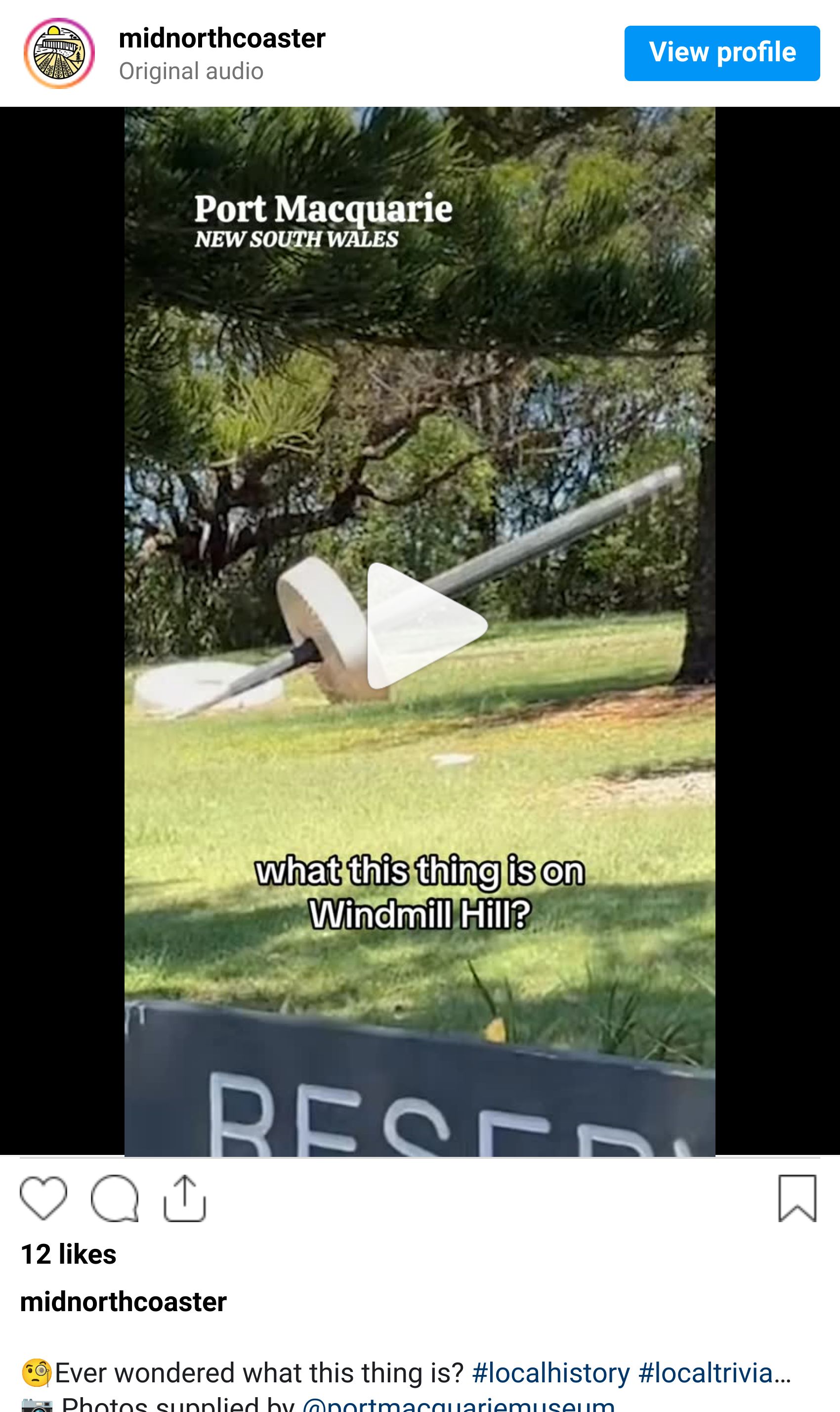
Port Macquarie locals and visitors to the area have probably been to Windmill Hill overlooking the ocean. Perhaps they’ve wondered what that strange, spiky looking thing is sitting on the grass in the middle of the reserve.
I’ve heard people say – given the name of the hill – they think it’s a part of an old windmill left over from its heyday.
But it’s not a relic. It is in fact a sculpture representing the wooden shaft and stone grinding wheels of a windmill that once stood on the site.
Created in the early 2000s by Rick Reynolds, the sculpture is called “Folly” after the original name of the area, Gillman’s Folly, after Captain Henry Gillman, an early commandant.
The original windmill: Major Archibald Innes, an 1800s soldier and pastoralist, had a windmill built there in 1825 to grind wheat and corn for government contracts – according to Arts Mid North Coast – and so it became known as Windmill Hill.
To find out more about Port Macquarie’s past, watch the video below and/or read the article on our website.
🗞️ Read the article including old photos…


🟡 Aunty remembered as a “trailblazer” who created long-lasting change across the country
Aboriginal and Torres Strait Islander readers are warned the following article contains images and names of deceased persons.
Flags were flown at half mast outside Kempsey Council Chambers on Thursday in memory of Aunty Mary-Lou Buck.
A “staunch advocate”: Dunghutti Elder, long-term Kempsey Shire resident and Life Member of the NSW Aboriginal Education Consultation Group, Aunty Mary-Lou is being remembered as a “staunch advocate” for Aboriginal people across the state and respected community leader who played a crucial role in securing land under Native Title legislation.
1996 to now: On October 9, 1996 – after two years of negotiations – Aunty Mary-Lou Buck and the then-NSW minister for lands, Kim Yeadon, signed an historic agreement at the Sydney office of the National Native Title Tribunal that granted the Dunghutti people 12.4 hectares of Crown land near Crescent Head.
At the time, the only other official recognition of native title was the High Court's Mabo ruling, which acknowledged Indigenous ownership of the Torres Strait Island of Mer.
The agreement also included hundreds of thousands of dollars in compensation for land that had already been sold for development as residential property.
Well known through NSW: Chairperson of Dunghutti Elders Council and brother of Buck, Clarry Hoskins, told the Mid North Coaster the Council’s office in South Kempsey was made possible thanks to the compensation – putting his sister at the centre of the positive work the group does for the Dunghutti people.
Hoskins said his sister was also the cultural advisor for the old highway bypass – advising on sites where the new roads would be built.
“She had a big responsibility,” Hoskins told the Mid North Coaster. “That was a part of her forte. Knowing communities and her acceptance with the other communities to engage with them to identify the sites. She was well known right throughout the state.”
While living in Sydney, Buck was part of the launch of a three-member Aboriginal Liaison Unit, making her the first female in this role at the Redfern office for NSW Police.
“She was a very staunch advocate not only for Dunghutti people, but for Aboriginal people all over the place,” Hoskins said.

Aunty Mary-Lou Buck. Picture supplied.

Inspired to teach: Buck’s impact on the education system, including fighting for Aboriginal people’s rights and culture to be incorporated into NSW Department of Education policies, syllabus and curriculum, is the reason Hoskins has a Bachelor of Secretary Teaching and a Masters in Indigenous Language today.
“Between her and mum, they inspired me to get my teacher’s degree,” Hoskins said.
Hoskins said his sister is being remembered as a caring person “for not only her community, but for her family as well”.

Thanks for catching up! I hope you enjoyed this issue, I’ll be back on Friday morning with another one focused on what’s happening across the region in March.
In the meantime, make sure you’re following along on Instagram, TikTok, YouTube, Facebook and our website to keep up to date with local news throughout the week.
Cheers,
Ellie